

Why Fibonacci Matters in Trading
The Forex market often feels unpredictable to new traders—fast, emotional, and chaotic. But what if price movement isn’t random at all? What if the market follows the same mathematical order found in nature itself?
This is where the Fibonacci sequence comes in. Understanding Fibonacci is not just about drawing lines on a chart—it’s about recognizing the hidden structure behind price action, market psychology, and human behavior.
Who Was Fibonacci? The Man Behind the Numbers
Leonardo de Pisa, famously known as Fibonacci, was born in Italy but educated in North Africa, where his father served as a diplomat. While traveling with his father, Fibonacci was exposed to advanced mathematical systems used across the Islamic world—systems far superior to the Roman numerals used in Europe at the time.
Around the year 1200, Fibonacci returned to Pisa and began introducing the numerical system 0–9, revolutionizing mathematics in Europe. He documented his discoveries in several handwritten works, including
- Liber Abaci (1202)
- Practica Geometriae (1220)
- Flos (1225)
- Liber Quadratorum (1225)
At the time, writing a book required extraordinary effort—everything was written by hand. Despite Fibonacci’s contributions, scholars debated the usefulness of the number zero for over 300 years.
Why Roman Numerals Failed—And Why Numbers Matter
Roman numerals made advanced calculations nearly impossible. Addition, subtraction, multiplication, and division were extremely limited. As a result, wealth couldn’t be accurately measured.
That’s why historians cannot quantify how wealthy figures like King Solomon or King Herod truly were. Today, using modern numerical systems, we can easily measure wealth—such as tracking the net worth of individuals like Bill Gates in real time.
Numbers create clarity. And clarity is exactly what traders need.
How Fibonacci Changed My Trading Life
Learning the Fibonacci sequence quite literally saved my trading career. Like many traders, I struggled deeply at the beginning—emotionally, financially, and mentally. There were moments when quitting felt inevitable.
Without a mentor, my trading dreams turned into nightmares. What kept me going was persistence—and the unwavering support of my wife.
When I finally discovered Fibonacci’s work, everything changed. His mathematics explained not only price movement but life itself.
Fibonacci and the Order of Nature
Fibonacci’s discoveries reveal how nature organizes itself—from pinecones and pineapples to galaxies and human DNA. The Forex market behaves the same way.
The market is not random chaos—it is organized chaos.
Price moves because of human emotion:
- Fear
- Greed
- Hope
- Habit
Markets are driven by people, not institutions. And people follow natural behavioral patterns—often unconsciously.
Discovering Fibonacci in Trading Software
When I first heard about Fibonacci retracement levels in the early 1990s, almost no one understood them. Even my market data provider—serving over 200,000 traders—had limited knowledge.
Eventually, a programmer added Fibonacci tools to my charting software. But when I asked how to trade with them, the answer shocked me:
“I’m just a programmer, not a trader.”
Once again, I was left to figure things out on my own.
Understanding the Fibonacci Numerical Sequence
The Fibonacci sequence follows a simple rule:
Each number is the sum of the two preceding numbers.
Examples:
1 + 1 = 2
1 + 2 = 3
2 + 3 = 5
3 + 5 = 8
5 + 8 = 13
8 + 13 = 21
21 + 34 = 55
34 + 55 = 89
55 + 89 = 144
This sequence continues infinitely—and appears everywhere in financial markets.
Fibonacci Ratios Explained (Critical for Forex Trading)
When Fibonacci numbers are divided, they consistently produce the same ratios:
- 0.382
- 0.50
- 0.618
- 0.786
- 1.27
- 1.618
Examples:
- 233 ÷ 144 = 1.618
- 144 ÷ 233 = 0.618
- 144 ÷ 377 = 0.382
These ratios remain consistent no matter where the sequence begins.
Where Do the Extra Ratios Come From?
- 0.50 → midpoint of a move
- 0.786 → √0.618
- 1.27 → √1.618
These ratios form the foundation of Fibonacci retracements and extensions used in Forex trading today.
Fibonacci Market Structure: Retracements & Extensions
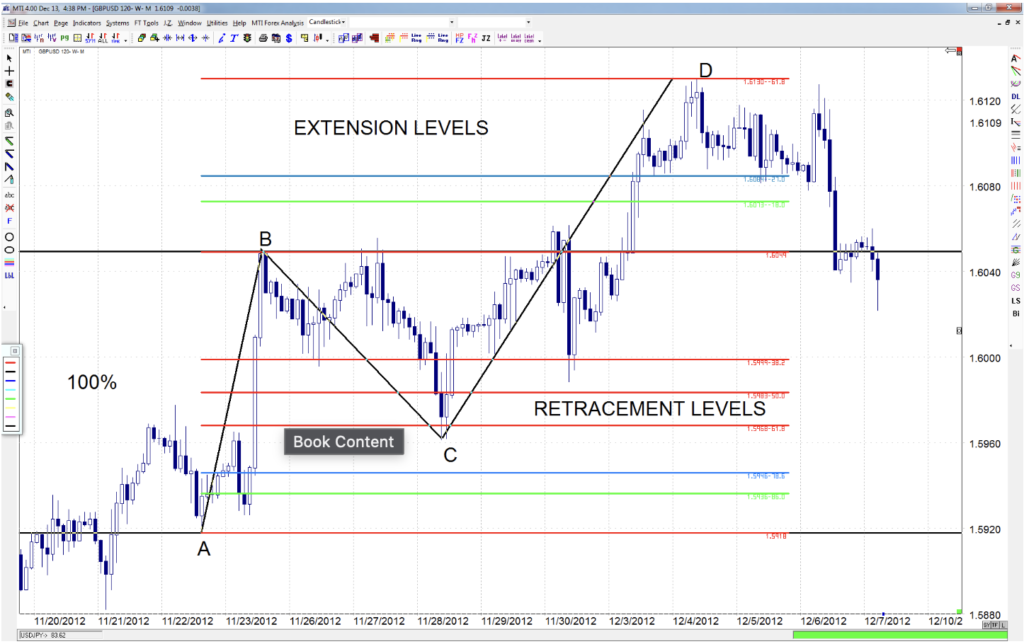
Markets move in waves, not straight lines. Fibonacci tools allow traders to identify:
- Pullbacks (retracements)
- Profit targets (extensions)
- High-probability reversal zones
When using Fibonacci:
- Connect point A to B
- Measure the C retracement
- Project the D extension
Modern charting platforms automatically calculate these levels, making analysis faster and more precise.
The Truth About the “Forex Holy Grail”
When traders first learn Fibonacci, it often feels like discovering the Holy Grail of trading.
But here’s the truth:
❌ There is no Holy Grail in Forex
✅ Success comes from:
- Correct knowledge
- Proven tools
- Strict rules
- Emotional discipline
Fibonacci is powerful—but only when combined with proper risk management and patience.
Final Thoughts: Fibonacci Is More Than a Tool
Fibonacci is not magic.
It’s a structure.
It is order within chaos.
It’s the bridge between nature, psychology, and price action.
When you learn to trade with Fibonacci, you stop guessing—and start understanding.
At GiantPips, we teach traders how to use Fibonacci the right way:
with discipline, clarity, and respect for market structure.
🔑 Key Takeaway
The market doesn’t move randomly.
It moves the way nature moves—and Fibonacci shows us how.
Trade With The Best Broker
if you want a broker that’s built for speed, stability, convenience with solid global licensing across multiple jurisdictions with reliable support, fast trade execution, speedy withdrawals, Exness is the best option to consider.